
 Great Britain
 USA
USA
 Germany


What Is Your Excuse?
None of us earns an invitation to Christ’s wedding feast. The people filling the banquet hall in the parable of the wedding feast were gathered from the roads—the good and the bad alike. Grace comes first, and the invitation comes first. But grace demands a response.
By Amy Servais, August 20, 2026 – EWTN Great Britain
There is something wonderfully simple about the imagery Jesus uses in the Gospels: seeds, sheep, lamps, coins, vineyards, bread, a father waiting for his son to come home, and a wedding feast. Christ speaks to people like us—people who do not always understand. The crowds gather around the feet of the Master, and He gives them stories: images drawn from ordinary life, simple enough to remember and deep enough to spend a lifetime contemplating.
He knows how we are made. We think in images and we remember stories. An idea may disappear almost as soon as we hear it, but an image can lodge itself in the imagination and remain there for years. Christ uses that imagination not merely to entertain us, but to feed the mind, penetrate the heart and, eventually, transform the life.
And so, He tells us about a wedding feast. It is an image almost everyone can understand. A wedding is something anticipated; an invitation arrives and immediately points towards a future day—a celebration of love, family, promise and new life, as two people we love step out into the great adventure of life together. We think about what we will wear, we arrange our journey, and we make room in the diary. We prepare because the occasion matters. Perhaps we remember our own wedding day: the anticipation, the nervousness, the preparations and the extraordinary sense that an ordinary day has somehow become unlike any other. And it is precisely this image that Christ chooses.
A king prepares a wedding feast for his son and sends his servants to summon those who have been invited, but they will not come. So, he sends them again: “Tell those who are invited: Behold, I have prepared my banquet.” Everything is ready, and still they refuse. Some simply ignore the invitation and return to their farms and businesses, while others respond with extraordinary violence, seizing the king’s servants, mistreating them and killing them. It seems almost fantastical. Who behaves like this when invited to a wedding? Perhaps that is precisely the point. When we see ourselves in the story, our excuses begin to sound equally absurd: the king has prepared a feast, the invitation has been delivered, and yet we have something else to do.
The Invitation
The first hearers of the parable would have understood something we can easily miss. Jesus is speaking within the long history of God’s covenant with Israel. The prophets had repeatedly used the imagery of marriage to describe the relationship between God and His people; Israel was the bride and God was the bridegroom. Now the Son has come, the long-awaited Messiah is standing before them, and the feast is ready. Yet the invitation is rejected, and so the servants are sent out again—this time to the roads and the streets, gathering everyone they can find, “bad and good alike,” until the wedding hall is filled with guests. The invitation has gone out to the whole world, including us.
You can almost see it: the doors thrown open, the room filling with strangers gathered in from the roads, the feast finally underway. And then this is where the parable becomes uncomfortable, because one man has entered without a wedding garment. The king approaches him: “Friend, how did you get in here without a wedding garment?” The man is silent. And he is cast out, into the darkness, where there will be weeping and gnashing of teeth—the same fate awaiting everyone who arrives in the same unpreparedness.
I have always found this part of the parable difficult; after all, if people have just been gathered from the streets, how can the king be so severe about what one of them is wearing? But perhaps that discomfort is precisely what should make us stop. The wedding garment is not simply about clothes. The man has accepted the invitation without allowing the invitation to change him. He wants the feast, but not the preparation; he wants admission, but not conversion; he wants to be inside the banquet hall while remaining exactly as he was outside it.
Christ will not allow us to confuse being invited with being ready. “For many are called, but few are chosen.”
At this point we could walk away—the whole scene feels harsh, arbitrary, even cruel to a guest gathered in from the street. Or we can stop, and ask what actually just happened.
The Wedding Feast
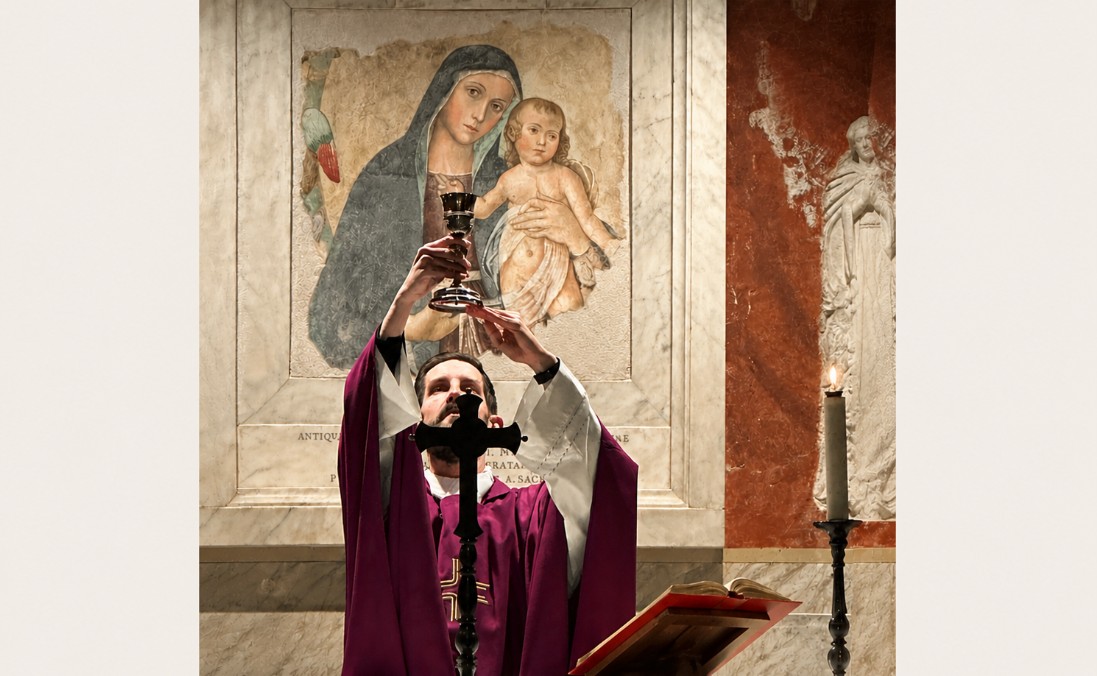
Catholic ears cannot hear the language of the wedding banquet without also hearing an echo of the Eucharist. Dr Scott Hahn famously explored this connection in The Lamb’s Supper, showing how the Mass participates in the heavenly wedding feast described in Revelation. At every Mass, something astonishing happens: the invitation is extended again, the sacrifice of Calvary is made sacramentally present, and Christ gives Himself to His Bride, the Church. Heaven touches earth, and beneath the appearance of bread and wine, the Lord remains among His people. “Blessed are those who are invited to the marriage supper of the Lamb.”
And we are invited—not metaphorically, and not someday. We are invited to come into the presence of the Holy of Holies, which raises an uncomfortable question: what’s our excuse? I’m tired, I’m busy, the children have sport, Sunday is my only morning to sleep, I have work to finish, Mass is boring, I don’t like the priest, I don’t like the music, I can pray at home, I’ll go next week. Perhaps we should hear those excuses against the background of the parable: “The feast is ready,” and I have something else to do.
But there is another danger, too. We can accept the invitation outwardly while refusing it inwardly. We can go to Mass every Sunday and never really arrive; we can sit in the pew while our minds remain elsewhere. We can fulfil the obligation, watch the clock, receive Communion and leave unchanged. We can be physically present at the feast while spiritually dressed for somewhere else. That is where the wedding garment begins to matter.
What Are We Wearing?
Scripture repeatedly uses clothing as an image of the spiritual life. We are told to “put on the Lord Jesus Christ”; Saint Paul speaks of the new self with which the Christian must be clothed, and Revelation describes the saints in white garments, washed in the Blood of the Lamb. The wedding garment, then, asks something far deeper than whether we have dressed smartly for Mass. Have we clothed ourselves in Christ? Have we come repentant, examined our conscience, sought reconciliation when conscious of grave sin, forgiven, prayed, and allowed grace to change anything?
Christianity is not merely accepting an invitation; it is becoming the kind of person who can enter the feast. That does not mean making ourselves perfect before approaching God. Quite the opposite. None of us earns the invitation; the people filling the banquet hall were gathered from the roads—the good and the bad alike. Grace comes first, and the invitation comes first. But grace demands a response. Christ meets us where we are, but He loves us too much to leave us there.
What’s Your Excuse?
Perhaps that is why this apparently simple parable continues to trouble us. It is meant to. Christ has planted an image in the imagination: a King, His Son, a wedding, a feast, an invitation, a room filled with guests, and one terrible question: how have you responded? The Christian life is filled with invitations—to Mass, to Confession, to pray, to forgive, to serve, to begin again, to follow Me—and how extraordinarily inventive we can become in finding reasons not to go.
Perhaps today is a good day to examine them. Perhaps it is time to order our lives toward the Lord, rather than around Him. What have I placed before God? What occupies the place that belongs to Him? What invitation have I repeatedly declined? And when I do come before Him, have I truly prepared my heart to encounter the One who invited me? The doors of the banquet hall remain open, the feast has been prepared, and the invitation has already been sent.
The question is not whether God wants us there; the question is whether we will come and whether, having come, we are willing to be clothed in Christ. So, perhaps the simplest question is also the hardest: what’s your excuse?
Support Catholic Media
As a charity, EWTN Great Britain relies on your support.
Help us bring you Catholic content.

Amy Servais is Studio and Production Manager at EWTN Great Britain, based in Walsingham, where she lives with her family. A video editor by profession, she has a deep love for the Church, evangelisation, and telling beautiful, faith-filled stories. She also writes reflective pieces drawn from her own experiences of faith.
Get EWTN Great Britain
in your inbox.